


1.
Come lift your hearts and voices,
And praise the Lord of grace;
For Patrick met Christ’s mercy
In every lonely place.
He learned the Bread of Heaven,
The Feast that makes us new,
And preached the living Presence
That burns the whole world through.

His love is old and beautiful,
His kingdom is divine;
His grace flows like a river—
A light in every time.
O Christ, my shield and refuge
In storms of days before,
And lifted by His holy cross
I walk in peace once more.

2.
By Kildare’s wells and meadows
Saint Brigid kept her flame;
She saw Christ’s holy Table
As hearth and heart the same.
Her cloak of gentle welcome
Still gathers me and you,
To taste the Cup of Kindness
Where Christ is shining through.

His love is old and beautiful…

3.
On winds of western waters
Saint Columba crossed the sea;
He carried Christ’s communion
With steadfast charity.
The chalice‑light of Iona
Still blesses all who kneel,
For Christ our Host is present—
His love the saints reveal.

His love is old and beautiful…

4.
So send us, Lord, like Patrick,
Like Brigid, Colum too—
From altar, cup, and blessing
Proclaiming Christ anew.
Fed by Your holy Body,
Your Blood our strength and song,
We walk the world in wonder
And bear Your peace along.

His love is old and beautiful,
His kingdom is divine;
His grace flows like a river—
A light in every time.
O Christ, my shield and refuge
In storms of days before,
And lifted by His holy cross
I walk in peace once more.
Reflection
For those of us with neurodivergent minds, the world is an intense tapestry of patterns, symbols, and sensory inputs. We don’t just see an object; we track its history, its emotional weight, and the way it connects to the landscape around us. For me, one of those hyper-fixated, unshakeable mental images lives inside my home parish church: a massive, Orange-style/Trade Union-style banner featuring Ireland’s three ancient patron saints—Patrick, Brigid, and Columba, on the other, usually unseen side, is the Connor Diocesan Arms.
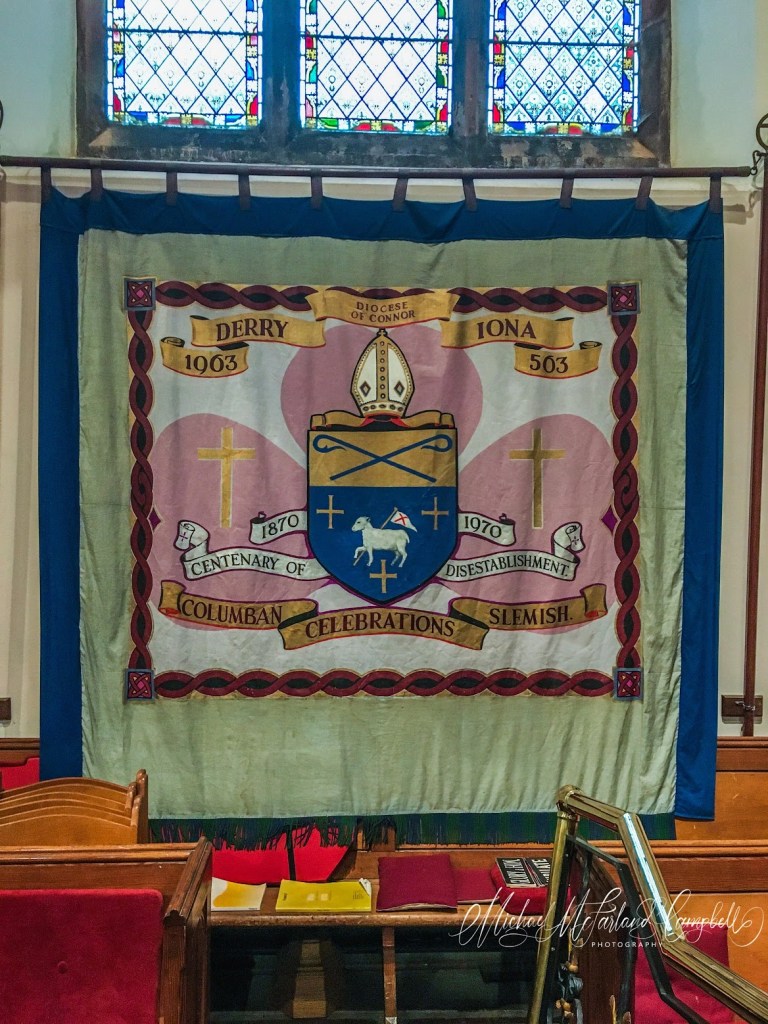
Historically, it was commissioned to mark the Columban celebration at Slemish in 1963, and later the centenary of the disestablishment of the Church of Ireland was added to it. To anyone walking past, it carries a very specific, loaded cultural weight. But the mind doesn’t always accept things at face value. A symbol can be reframed.
In Irish history, music and banners have long been used to mark territory in the sectarian soil. Perhaps no melody carries more heavy, political, and tribal gravity than the traditional air “Irish Molly O”—known almost universally across these islands as the tune to “The Sash.” It is a driving, rhythmic 6/8 march designed to make a point, to mark territory, and to look backwards.
But what happens when we look further back? What happens when we strip away the noise of centuries of division and re-tune the melody to something older, more beautiful, and entirely divine?
Subverting the Pattern
As a neurodivergent person, I love a good subversion of a rigid system. True healing often requires us to take the very things that cause friction or pain and re-code them.
The three saints on that parish banner—Patrick, Brigid, and Columba—belong to an era of Celtic Christianity that predates all of our modern fractures. They lived long before the divisions of Protestant or Catholic, Unionist or Nationalist. They knew the rugged Irish landscape, the radical laws of hospitality, and the absolute reality of Christ’s presence in the breaking of the bread.
By rewriting a Eucharistic hymn to the exact meter of “The Sash,” the goal is an act of spiritual and cultural reclamation.
When you sing about Patrick finding mercy in “every lonely place,” Brigid setting her table as a “hearth,” and Columba carrying “Christ’s communion” across the western waters, something incredible happens to the brain. The driving, assertive rhythm of a sectarian march is suddenly tamed and transformed into a joyful, pacing dance toward the altar.
The very melody once used to declare an earthly loyalty is repurposed to proclaim a divine one.
Healing the Landscape
At NeuroDivine, we often reflect on how places, memories, and symbols shape the way we encounter God. Ireland’s landscape carries deep beauty, but it also carries deep wounds. When we take the image of a familiar banner, pair it with a familiar melody, and centre both upon the Eucharist—the Bread of Heaven that breaks down every wall—we are doing more than writing another hymn.
We are reclaiming the rhythm.
We are allowing Christ to redeem memories as well as melodies. We are taking symbols that have often divided neighbours and asking whether they might instead point us towards the saints we share, the table we share, and the Lord who gathers us all.
The next time I look at that banner, or hear the opening notes of that old tune, I hope I will hear something different: not a call to remember old divisions, but an invitation to Christ’s peace.
Hymn information
First line: Come, lift your hearts and voices
Text: Michael McFarland Campbell
Metre: 86 86 D
Tunes: Irish Molly O (the Sash)
Scripture: John 6:51, John 20:21
© 2026 Michael McFarland Campbell. Permission granted for local church use with attribution. Not for commercial reproduction without permission.


Leave a Reply