



Tonight I am lying on the living-room floor.
There is a Sherpa blanket beneath me and another over me. Two pillows. Otto and Custard beside me. The window is open and the September air comes quietly into the room.
I am exhausted.
Not dramatically so. Not in crisis. Simply tired in that deeper way that sometimes comes with years of dialysis: tired of getting up again, travelling again, sitting in the chair again, connecting to the machine again, and knowing that after one treatment there will always be another.
Earlier I watched Abbot Christopher Jamison speaking at Westminster Abbey about the Benedictine tradition. One thought stayed with me: that the cloister need not be confined to the monastery. We can learn to make the place where we actually are into a place of attention, prayer and encounter with God.
It made me think immediately of my prayer in the dialysis chair.
I have often had to learn that lesson there.
The dialysis unit does not look much like a monastery. There are machines and alarms, bloodlines and observations, staff moving between patients, televisions, conversations and the long measured passing of hours.
Yet the chair can become a kind of stall in the choir.
The machine’s rhythm can become the background to prayer.
The hours which I cannot escape can become hours which, however imperfectly, I offer.
Perhaps that is part of what Benedictine stability can mean outside the monastery: not necessarily choosing the place in which we find ourselves, but learning sometimes to remain there attentively.
And tonight the cloister is somewhere else again.
It is the living-room floor.
There are no carved arches. No ancient stones. No procession passing along the covered walk.
There is a blanket.
An open window.
Two bears keeping watch.
And a very tired man lying still.
Six months ago I wrote The Hum of Lines, born from another night of exhaustion and from the strange, repetitive world of dialysis. Its resolution was deliberately not triumphal. There are times when faith does not feel like victory.
Sometimes it is simply remaining.
Breathing.
Being held.
Allowing the place where I happen to be to become, for a little while, holy ground.
And sometimes even prayer itself has to become very small.
In the shorter version of my hospital rosary there is a prayer I return to again and again:
Jesus, remember me, when you come into your kingdom.
I did not write that little rosary because I thought other people needed it.
I wrote it because I did.
Because there are hospital rooms and dialysis chairs and exhausted nights when a long prayer is too much. There are times when theology has to become a sentence. Times when the whole weight of faith has to fit into a handful of words.
Tonight I need those words again.
Jesus, remember me.
Perhaps that is why the NeuroDivine prayer books exist at all.
They begin not with the question, “What should other people pray?” but with another one:
“What can I pray when I have almost nothing left?”
And then, sometimes, the prayer written out of one person’s need becomes a prayer another person can borrow.
That feels important to me.
These are not prayers written from a distance.
They are prayers from the chair.
From the hospital bed.
From the railway platform.
From the waiting room.
From the living-room floor.
Prayers written because first of all I needed somewhere to put my fear, my gratitude, my exhaustion, my hope.
And perhaps tonight I want the angels back.
I have known that feeling before.
Years ago, lying still during an aromatherapy massage in Belfast, I had the overwhelming sense that the four corners of the room were guarded. Angels with wings and swords seemed to stand there — not threatening, but protective. The swords felt like boundaries. The wings felt like shelter.
The room became, for a little while, sanctuary.
I wrote about it later in Angels in the Corners. What mattered was not that anything dramatic happened. Nothing was fixed. Nothing was explained. I simply felt held.
Tonight I find myself wanting that again.
Four corners.
Four guardians.
One beside the open window.
One near the door.
Others standing quietly at the edges of the room, keeping watch while Otto and Custard keep their softer vigil beside me.
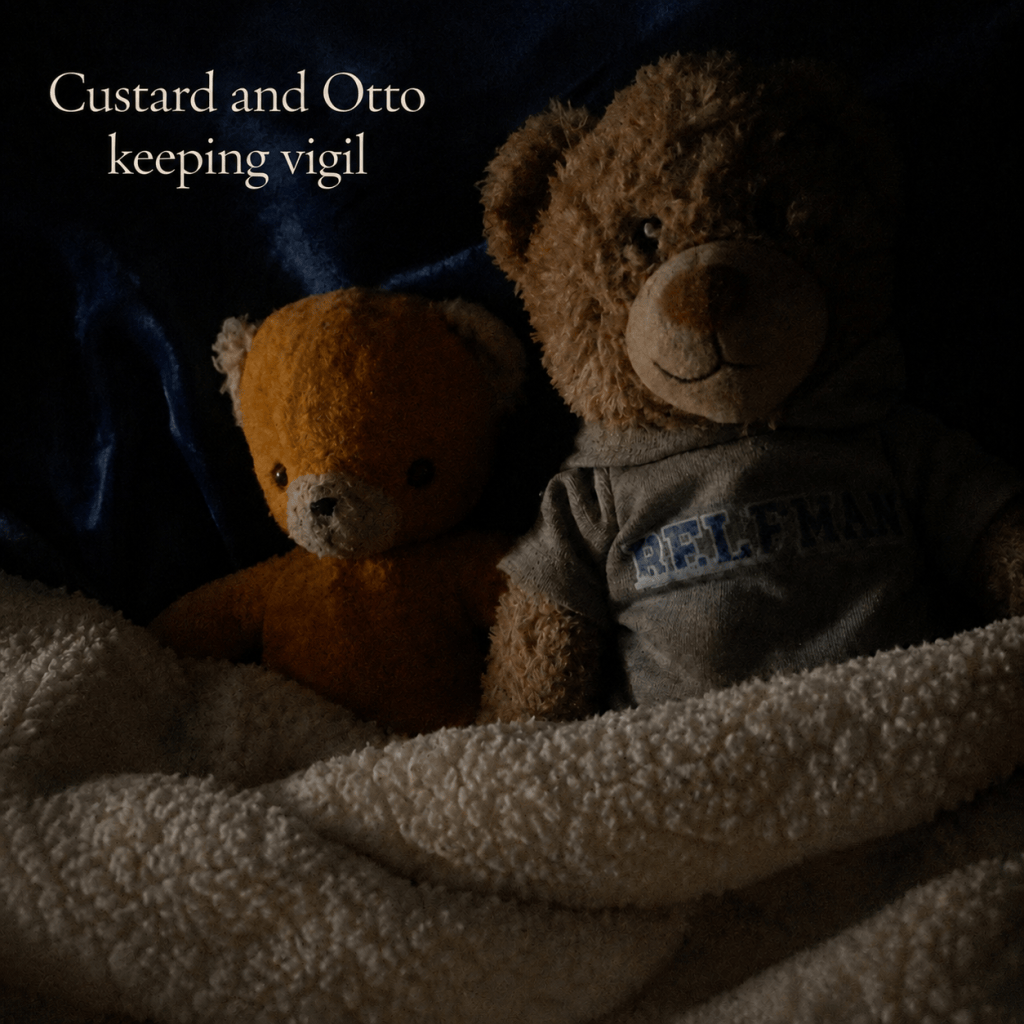
I do not need the angels to lift me from the floor.
I do not need them to make dialysis disappear, or to promise that tomorrow will be easier.
I only want to know that I am guarded.
That heaven can touch earth here too.
That the boundaries of this little makeshift cloister are held.
There are nights when prayer is words.
There are nights when prayer is silence.
And there are nights when prayer is simply:
Jesus, remember me, when you come into your kingdom.
Tonight, perhaps, that is enough.
A living-room floor.
Two blankets.
Two bears.
An open window.
A very tired man.
And angels in the corners.


Leave a Reply