



Hymns | Proper 14 Year A | 9 August 2026
Through shadow, sorrow and storm, Christ walks towards us, feeds us, and sends us onward.
When shadows fall on pilgrim paths
1.
When shadows fall on pilgrim paths,
Your hidden mercies rise;
You lift us from the depths of fear
And call our hearts to rise.

2.
Your wonders move through famine nights
And whisper on the breeze;
You send Your word on wandering feet
To heal what storms unseat.

3.
In glens where ancient sorrows rest
Your guiding light is found;
You steady those who bear Your peace
Across the trembling ground.

4.
When moonlit waves begin to roar
And doubts like tempests swell,
You walk the waters toward our need
And speak the word we tell.

5.
From Christ, the Bread of living fire,
We journey in His light;
His flame our path, His peace our call—
Goes forth in grace and might.
Hymn Information
First line: When shadows fall on pilgrim paths
Text: Michael McFarland Campbell
Metre: CM
Tune: Ballerma
Theme: Proper 14 Year A
© 2026 Michael McFarland Campbell. Permission granted for local church use with attribution. Not for commercial reproduction without permission.
Reflection
There are journeys we choose, and journeys that seem to choose us.
Some begin with excitement and expectation. Others begin when the familiar road disappears beneath our feet: through illness, grief, uncertainty, displacement, fear, or simply the knowledge that life has changed and cannot return to what it was before.
This hymn is a song for that kind of pilgrimage.
It begins not in certainty, but in shadow:
When shadows fall on pilgrim paths,
Your hidden mercies rise.
The mercy of God is not always obvious. Sometimes we recognise it only afterwards. Sometimes it comes through another person, an unexpected kindness, a word spoken at precisely the right moment, or the strength simply to continue when we thought we had none left.
The Christian hope is not that shadows never fall. It is that the shadows do not have the final word.
God meets us within them and calls us to rise.
The Word that travels
The second verse widens the landscape. We move into famine nights, wandering feet, wind and storm.
You send Your word on wandering feet
To heal what storms unseat.
God’s Word is not static. Throughout Scripture, God sends people out: Abraham journeys into an unknown country; Moses leads a people through wilderness; prophets travel with uncomfortable words of truth and hope; the apostles are sent beyond everything familiar to them.
And ultimately, in Christ, the Word Himself comes among us.
This is a God who travels.
That matters when our own lives feel unsettled. Faith does not depend upon our remaining in one safe and predictable place. God can meet us on the road, beside the hospital bed, on the train, in the unfamiliar room, in the strange city, or in the landscape through which we are simply passing.
Grace has wandering feet.
Peace in trembling places
The third verse brings us into the glens:
In glens where ancient sorrows rest
Your guiding light is found;
You steady those who bear Your peace
Across the trembling ground.
Some landscapes carry memory.
Ireland knows this particularly well. Hills, glens, roads, rivers and townlands can hold stories of famine, migration, conflict, division, prayer and reconciliation. Beauty and sorrow often inhabit the same ground.
Christian peace cannot mean pretending those wounds never existed.
The peace of Christ asks us to remember without becoming imprisoned by memory; to acknowledge wounds without allowing them to dictate the future; and to walk into trembling places carrying something other than another weapon.
Peacemaking requires steadiness because reconciliation is rarely comfortable.
Yet God is already present in those places of ancient sorrow. The guiding light is not brought there for the first time by us. We discover that God has been there before us.
Our task is simply to bear the peace we have received.
Christ upon the water
Then the landscape changes again.
Night falls upon the sea.
When moonlit waves begin to roar
And doubts like tempests swell,
You walk the waters toward our need
And speak the word we tell.
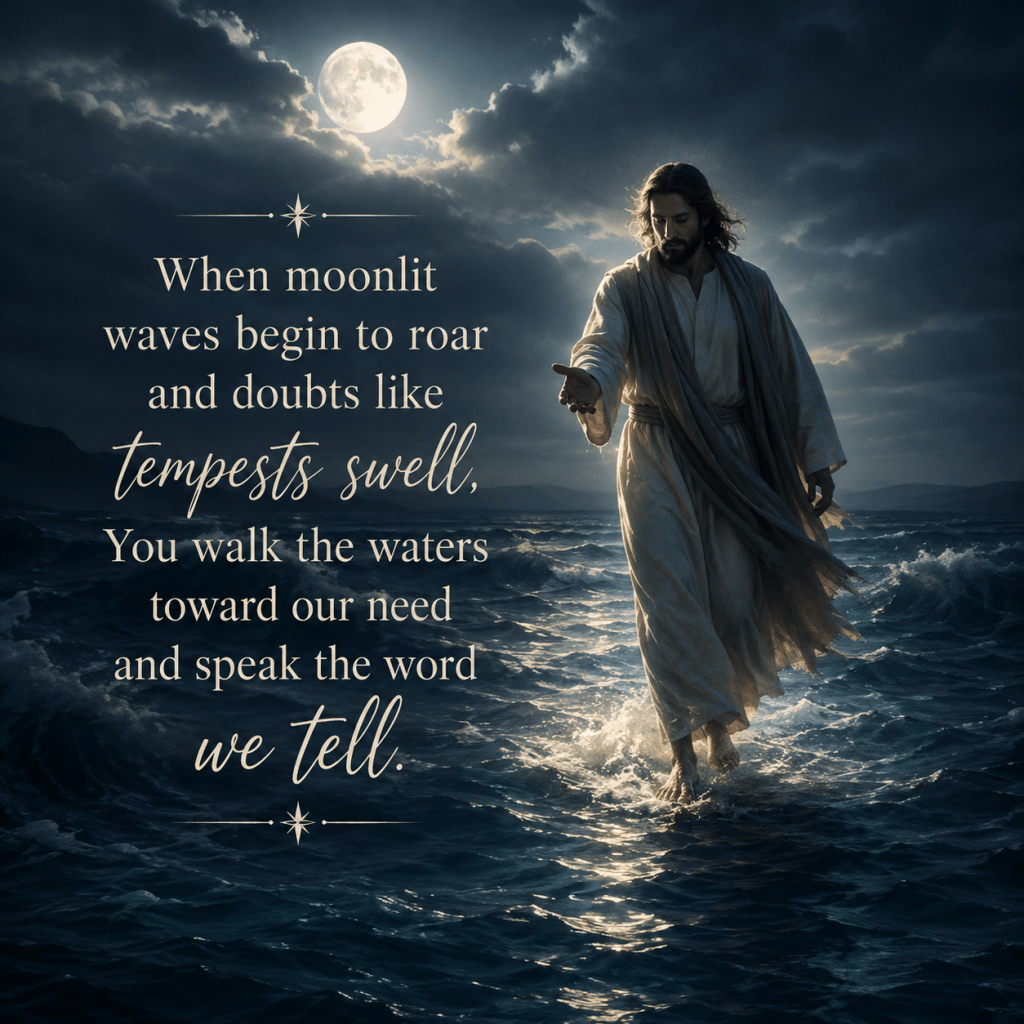
The image recalls the Gospel accounts of Jesus coming to his disciples across the water.
The disciples are surrounded by forces they cannot control. Wind and water have overwhelmed their little boat. And Christ does something extraordinary: he comes towards them through the very thing they fear.
That is one of the deepest images of Christian hope.
Christ does not always remove the storm before coming to us.
Sometimes he comes through it.
There are times when we pray desperately for the sea to become calm, while grace is already approaching us across the waves.
Faith, then, does not require the absence of doubt. Doubt itself can swell like a tempest. Faith may simply be the willingness to recognise the figure coming towards us in the darkness and hear again:
Do not be afraid.
Bread for the road
The final verse brings the hymn to Christ the Bread of Life:
From Christ, the Bread of living fire,
We journey in His light;
His flame our path, His peace our call—
Goes forth in grace and might.
The pilgrimage does not end at the altar.
We are fed so that we may be sent.
In the Eucharist, Christ gathers the scattered, feeds the weary and gives himself to us in bread and wine. But Communion is never merely a private moment between the individual and God. We receive Christ in order to become more fully the Body of Christ in the world.
The Bread becomes strength for the road.
The light becomes a flame carried into darkness.
The peace we receive becomes the peace we are called to bear.
And so the hymn ends where Christian worship itself ends: with sending.
We have travelled through shadow, famine, ancient sorrow and storm. We have discovered God’s mercy hidden within them. And having been met, healed, steadied and fed by Christ, we are sent back onto the pilgrim road.
Not because every shadow has disappeared.
Not because every storm has become calm.
Not because every ancient wound has healed.
But because Christ goes with us.
Perhaps that is enough for pilgrimage: to discover, step by step, that wherever the road leads, God’s mercy has already gone ahead.
And when the path grows dark, the ground trembles or the waters rise, we may yet discover Christ walking towards us.


Leave a comment