


For more than seventy years, the sixth of February carried a singular weight in the United Kingdom and other Commonwealth realms. As Accession Day, it marked the moment when private loss and public duty first converged, and over time it became a fixed point in the national memory—quietly observed rather than celebrated.
I wrote this poem holding dual nationality, as both an Irish and a British citizen: someone who grew up in the United Kingdom and now lives in Ireland. Here, Accession Day is not formally marked, nor is it part of the civic calendar. Yet privately, and personally, the date has continued to matter. It has remained a reminder of continuity shaped by restraint, and of a form of duty carried without spectacle.
The poem was inspired by the moment when that long-held observance ceased. With the death of the Sovereign on 8 September 2022, the crown passed again—this time on a different day, already marked in the Christian calendar as the Nativity of Our Lady. A new reign began, and the sixth of February was released from its particular meaning.
What follows reflects on that change and on how history is experienced differently depending on where one stands. It considers succession as both inheritance and cost, and listens for what remains when a date once set apart becomes, once more, an ordinary day.
When the Sixth Returned
For seventy years and more,
one date the kingdoms knew:
the sixth of February
when reign and memory grew.

A winter morning stilled,
yet history stirred awake;
the Crown passed in a breath,
a life closed, another stake.

The bells rang soft and strange that day,
not triumph, but a sigh—
for duty’s quiet mantle
had settled from on high.

And those who marked that change,
from hearth or palace gate,
felt time itself lean forward
and recognise the weight.

So every sixth of February,
the memory stood apart:
a mingling of the public
and the chambers of the heart.

Until the eighth of September,
when Our Lady’s birth is named,
a seventy-year keeping ends,
a different day is claimed.

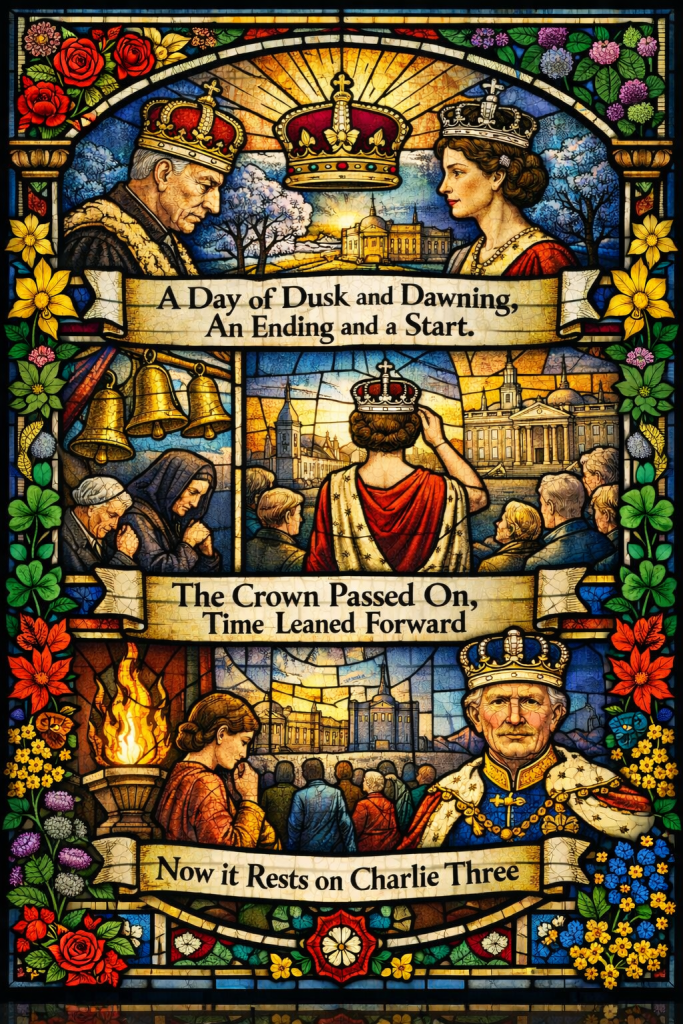
A day of dusk and dawning,
of endings twinned with start—
a sovereign’s final vigil,
a son’s accepting part.

And now that sixth returns,
unmarked by crown or key;
the Crown has crossed its threshold—
it rests on Charlie Three.
Copyright 2026 Michael McFarland Campbell.


Leave a Reply