



Notes on writing, technology, and the long journey from thought to book
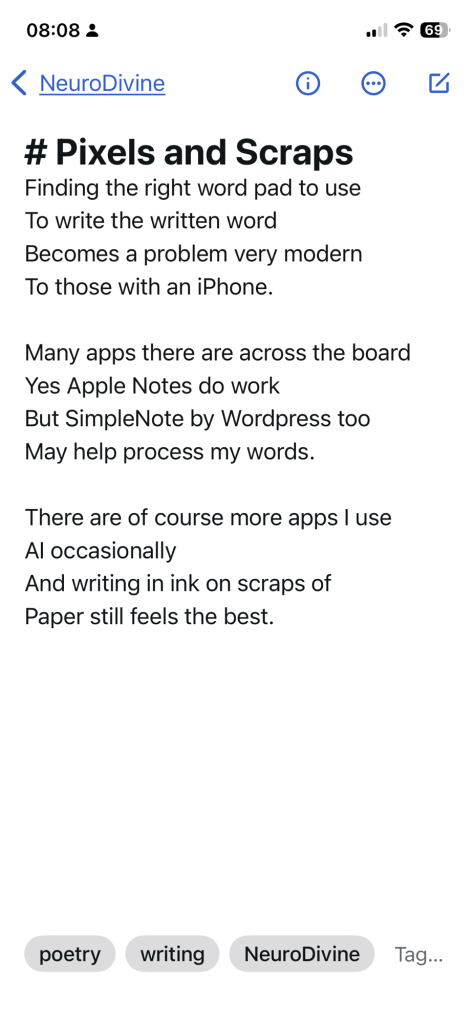
The poem made me smile because beneath the references to phones, apps, and technology lies a much older question: where do words begin, and how do they become something worth sharing?
Every piece of writing begins somewhere. Rarely does it begin at a desk.
A hymn might arrive while I am sitting in dialysis. A poem may emerge on a railway platform. A reflection may begin during a church service, on pilgrimage, or in the middle of an ordinary conversation. Sometimes it is only a phrase. Sometimes a single image. Sometimes nothing more than the faint tug of a thought asking to be noticed.
The first challenge is not writing.
The first challenge is catching the thought before it disappears.
For centuries, writers carried notebooks. Many still do. I certainly own enough of them. Yet the modern writer is surrounded by a bewildering array of alternatives. A thought may be captured in Apple Notes. A line of poetry may land in Simplenote. A paragraph may be dictated into a voice recorder while walking down a street. Sometimes a conversation with an AI helps untangle an idea that has become knotted somewhere between imagination and language.
The tools change. The task remains the same.
Most ideas begin as fragments:
a scripture verse, a memory, the lift of a curlew from a field, a line overheard in a café, a moment of grief, a moment of joy, the smell of rain on warm pavement, the sound of an organ filling a church before the congregation arrives.
These fragments accumulate.
Some remain fragments forever. Not every note becomes a poem. Not every poem becomes a reflection. Not every reflection deserves publication. Writing involves waiting. Ideas need time to mature. A thought that seemed brilliant on Tuesday may reveal itself to be rather ordinary by Thursday. A scribble on the back of an envelope may quietly grow into something substantial.
Eventually, connections begin to emerge.
A hymn finds its tune. A poem discovers its rhythm. Several unrelated notes reveal that they have been circling the same theme all along. What once looked like scattered pixels and scraps begins to cohere.
Then comes revision.
Words are added. Words are removed. Paragraphs migrate. Sentences are rewritten because they are trying to say something the heart did not intend. Revision can be frustrating, but it is also where much of the craft resides. Inspiration may begin a piece, but revision shapes it.
Only then does WordPress enter the story.
By the time a post appears on NeuroDivine, most of the work has already happened. The writing has travelled from thought to note, from note to draft, from draft to reflection. WordPress becomes the place where the piece is prepared for readers and released into the world.
For many writers, publication marks the end of the journey.
For me, it often marks the beginning of another.
A hymn first published online may later appear in a collection. A reflection may become part of a book. A poem written while travelling may find itself gathered with others around a common theme. The digital post begins a second transformation.
Pixels become ink.
Screens become paper.
What began as a fleeting thought captured on a phone or a scrap of paper acquires weight, texture, and permanence. The blog post becomes a page, and the page becomes part of a codex.
I have always loved that ancient word: codex. It sounds scholarly and monastic, and perhaps that is why it appeals to me. Yet a codex is simply a book—a gathering of pages bound together and preserved for future readers. Long before printing presses, monks copied texts into codices by hand. Long before websites and blogs, words travelled from mind to parchment and from parchment to reader.
In some ways, very little has changed.
The technologies are different. The journey remains remarkably familiar.
A thought is born.
A note is made.
A draft takes shape.
A reflection emerges.
A post is published.
And sometimes, if the words continue to speak, they make one final journey—from WordPress to codex.
That possibility still delights me.
For all the convenience of digital publishing, there is something deeply satisfying about holding a finished book. A blog post can be scrolled past in seconds. A book waits patiently on a shelf. It can travel in a pocket, sit beside a bed, accompany a pilgrimage, or survive long after its author has been forgotten.
Perhaps that is why I continue to write.
Not because every note will become a poem.
Not because every poem will become a reflection.
Not because every reflection will become a book.
But because every finished work begins with a single thought caught before it flies away.
Whether on a phone screen, in a notes app, or on the back of an envelope, the journey always starts in the same place.
With a few words.
And the hope that they might become something more.


Leave a Reply